
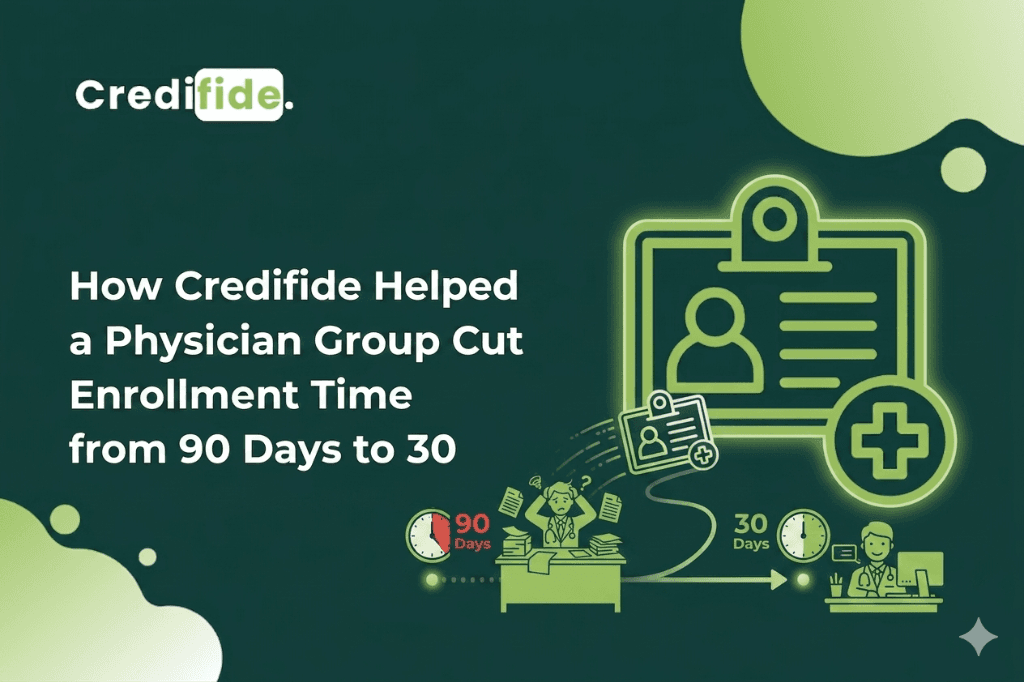
The Staggering Cost of a 90-Day Wait
Ninety days. That is how long a mid-sized physician group in the Midwest was waiting on average for each new provider to complete payer enrollment. Ninety days of a physician seeing patients, building relationships, and doing the clinical work they were hired to do while the billing clock sat frozen because insurance credentialing hadn't cleared yet.
Over a 12-month period, they brought on 11 new providers. At 90 days per enrollment, across multiple payers per provider, the revenue gap that quietly accumulated in their RCM system was staggering. Their revenue cycle director knew something was wrong. She just didn't have the tools to see exactly where.
That's the moment they contacted Credifide.
By the end of the engagement, average enrollment time had dropped from 90 days to 30. Claims went out on time. Denials dropped. And the team that had been spending hours every week chasing payer portals and lost emails could finally focus on something other than damage control.
Beyond the Wait Time: The Hidden Costs
When people talk about slow physician enrollment automation, they usually focus on the obvious cost: delayed billing. And yes, that cost is real. A physician generating $8,000 to $12,000 in daily billings, delayed for 90 days, represents a revenue gap that rarely gets fully recovered. Payers don't pay retroactively just because your paperwork finally came through. Most of what was lost during that window stays lost.
But the hidden costs are just as damaging and far less discussed:
- Administrative Burden: Hours spent manually tracking applications across dozen payer portals, sending follow-up emails into voids, and updating spreadsheets that are already out of date by the time they're saved.
- Compliance Risk: When enrollment takes too long and pressure mounts, shortcuts happen. Billing under a supervising physician's NPI as a workaround is more common than anyone in healthcare administration wants to admit. It can be catastrophic in an audit.
- Human Cost: Providers who joined your group excited about their new role, now watching their first weeks and months get tangled in paperwork delays they don't fully understand and can't control.
What Credifide Found
Before building a solution, Credifide's team mapped the existing enrollment workflow step by step. What they found was not a team that wasn't trying-everyone was working hard. The problem was structural:
- Reactive Collection: Documents were collected only after applications were ready to go out, causing delays right at the start while licenses, DEA certificates, and malpractice history were tracked down from providers who had other things on their mind.
- Batched Submissions: Applications were being submitted to payers in batches rather than as each document set was completed. This meant that an application ready to go on a Tuesday sat waiting until the next batch ran on Friday, adding days to every single submission.
- Calendar-Based Follow-ups: Payer follow-ups were calendar-based rather than trigger-based. Someone would check in with a payer every two weeks regardless of whether there was a reason to. Urgent requests for additional information sent by payers sat unnoticed in email inboxes for days.
- Re-credentialing Gaps: Re-credentialing deadlines for existing providers were tracked in a spreadsheet that had not been audited in over a year. Three providers were already past their re-credentialing window without anyone realizing it.
Rebuilding the Process from the Ground Up
The fix was not about working harder. It was about redesigning the workflow so that delays became structurally impossible rather than routinely expected.
1. Front-Loaded Document Collection
The first change was moving document collection to the front of the process. The moment a provider accepts an offer, Credifide's system sends them a structured checklist. Providers submit documents into a secure centralized portal. Nothing moves forward until the file was complete. This alone eliminated the most common source of early delays.
2. Eliminating Batched Submissions
The second change was eliminating batched submissions. Every application was submitted to payers the moment the documentation was verified and completed-individually, immediately, not in groups. For this physician group, that change alone reduced average time-to-submission by 11 days.
3. Real-Time Trigger-Based Alerts
The third change was replacing calendar-based follow-ups with real-time trigger-based alerts. Credifide's platform monitors every active application and flags the moment a payer requests additional information, sends a status update, or goes beyond the expected processing window. Response times to payer queries dropped from an average of nine days to under two.
4. Single-Owner Accountability
The fourth change was assigning a single named owner to each provider's credentialing file. Not a team. Not whoever was available. One person, one file, complete accountability from submission to approval. Every status update, every payer communication, and every pending document request ran through that owner.
5. Automated Re-credentialing
The final change was building re-credentialing deadlines directly into the Credifide platform at the moment of initial enrollment. Every existing provider's upcoming deadline was entered and automated reminders were set 90, 60, and 30 days out. The spreadsheet was retired.
The Results: After 90 Days with Credifide
Within the first 90 days of working with Credifide, the physician group's metrics changed measurably across every area that had been causing problems:
- 68% Reduction in Enrollment Time: Average time from offer acceptance to first billable claim dropped from 91 days to 29 days.
- 41% Lower Denial Rate: Claims denial rate related to credentialing and enrollment errors dropped by 41 percent.
- 50%+ Administrative Efficiency: Staff who spent 15-20 hours per week managing enrollment manually were spending fewer than 8 hours on the same workload.
Insurance credentialing does not have to be a 90-day problem. For the physician group in this story, it no longer is. Book a walkthrough with the Credifide team to see how we can transform your enrollment timeline.